Introduction
Caching, as explained in previous article, is not a single technique but a set of strategies. Each strategy defines how the application interacts with the cache and the database, especially in terms of read and write behavior.
The differences between these strategies are not minor implementation details. They directly affect performance, consistency, complexity, and failure handling. In the following , we will go through the cache-aside strategy.
Cache-Aside (Lazy Loading)
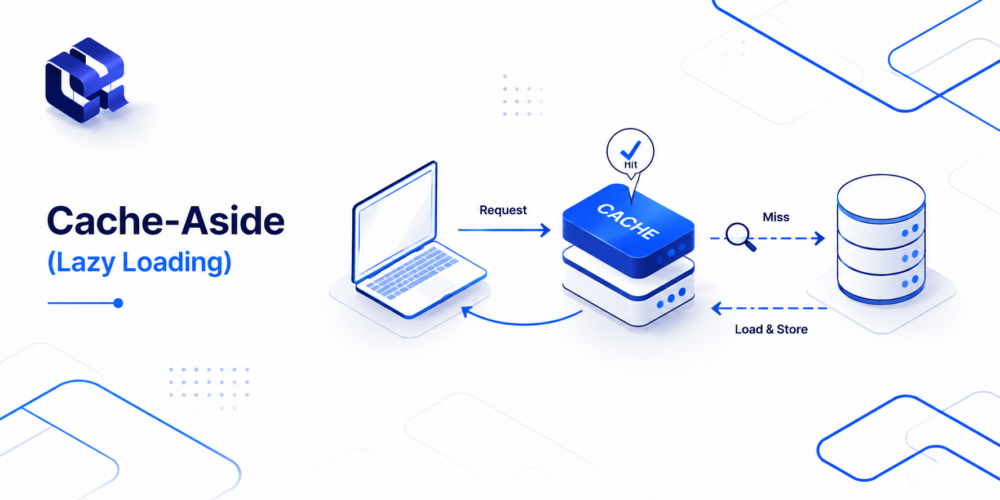
Cache-aside is one of the most commonly used caching strategies. In this approach, the application is responsible for managing both the cache and the database. The process is simple: the application first checks the cache for the requested data. If the data is found (a cache hit), it is returned directly from the cache. If the data is not found (a cache miss), the application retrieves it from the database and then stores it in the cache for future requests.
In other words, the application is responsible for keeping both the database and the cache consistent. It should implement strategies to ensure that cached data remains up-to-dated. The application must also detect when cached data becomes stale and refresh or invalidate it appropriately.
This approach is called cache-aside because the cache is populated only when the application needs the data, rather than being populated in advance.
How it Operates
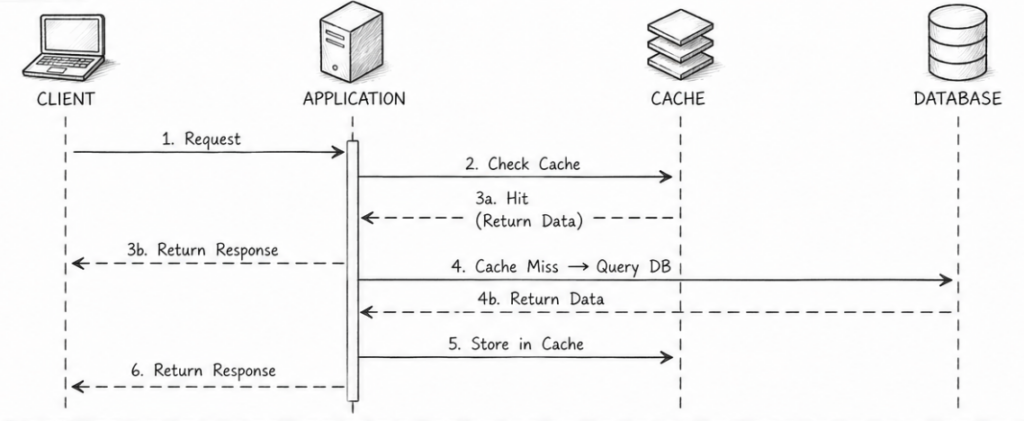
The flow follows actually a predictable pattern. When a request arrives at the application, the application first checks the cache. If the requested data is already available in the cache, it is returned immediately. If the data is not found in the cache, the application queries the database, retrieves the result, stores it in the cache for future requests, and then returns the response to the client.
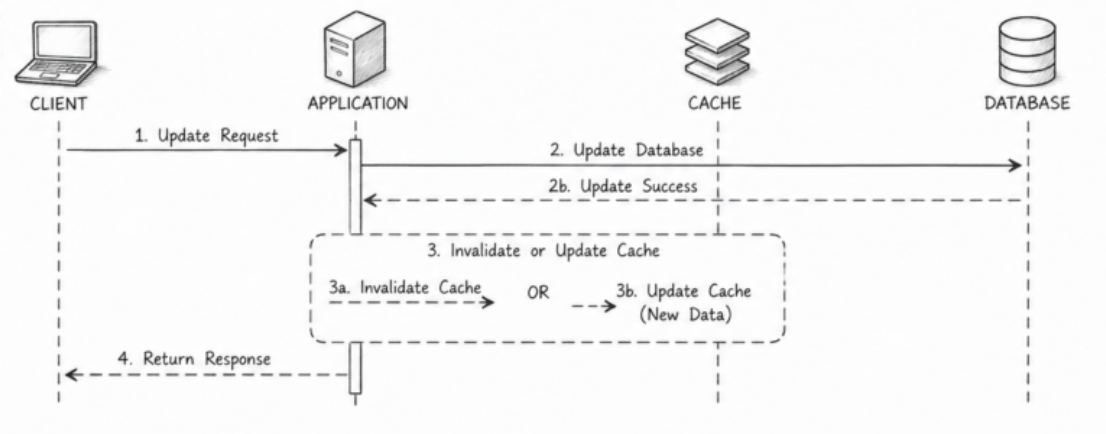
When data is updated, as mentioned, the application is responsible for maintaining consistency between the database and the cache. Typically, the application first updates the database and then either invalidates the corresponding cache entry or updates the cached value to ensure that future requests receive fresh data.
Pros & Cons
Cache-aside works well because it gives the application full control over how caching is handled. It is particularly effective in scenarios where read operations are much more frequent than write operations, only a subset of the data is accessed frequently, and fine-grained control over caching behavior is required.
Another advantage of the cache-aside approach is that it avoids caching unnecessary data. Since data is added to the cache only when it is requested, the cache stores only the information that is actually being used by the application.
Cache-aside is fundamentally about control and simplicity. In this pattern, the application decides when to read from the cache, when to query the database, and when to update or invalidate cached data. This level of flexibility allows applications to optimize caching behavior based on their own access patterns and consistency requirements.
That flexibility is also the reason cache-aside is the most widely used caching strategy. However, because the application is responsible for managing cache consistency, it must carefully ensure that cached data remains correct and up-to-date.
Cache-Aside Trade-Off
Cache-aside is a simple and widely used pattern, but it is not free of challenges. In the following sections, we will briefly look at some of the common trade-offs associated with this approach.
Risk of stale data
One of the main challenges of the cache-aside pattern is the risk of serving stale data. If the application updates the database but fails to invalidate or refresh the corresponding cache entry, clients may continue to receive outdated information from the cache. This issue becomes more noticeable in distributed systems where multiple application instances may interact with the same cached data.
To reduce this risk, applications often use strategies such as:
- Cache expiration (TTL)
- Explicit cache invalidation after writes
- Version-based updates.
Choosing the right invalidation strategy is critical because cache consistency is managed by the application itself in the cache-aside approach.
Cache misses are expensive
Another tradeoff of the cache-aside pattern is the cost of cache misses. When the requested data is not available in the cache, the application must query the database before returning a response, which increases latency for that request. This is especially noticeable for frequently accessed data immediately after cache eviction or expiration.
In high-traffic systems, multiple simultaneous cache misses for the same data can also create additional load on the database, a problem often referred to as a cache stampede. To mitigate this, applications may use techniques such as:
- Request coalescing
- Background cache warming
- Longer expiration policies for hot data
Cache inconsistency window
The other tradeoff of the cache-aside pattern is the existence of a small inconsistency window. During this period, the database has already been updated, but the cache may still contain stale data until it is invalidated or refreshed. As a result, some requests may temporarily receive outdated information.
This issue is difficult to eliminate completely because cache and database updates are typically separate operations. In distributed systems with concurrent requests, the inconsistency window can become more noticeable, which is why many applications accept eventual consistency as a practical tradeoff for improved performance.
Additional application logic
Another tradeoff of the cache-aside is the additional complexity introduced at the application layer. The application must explicitly handle cache reads, cache writes, cache invalidation, and failure scenarios. This increases the responsibility of the application and makes the overall system logic more complex.
As the application grows, maintaining correct cache behavior across different services and workflows can become difficult. Developers must carefully design caching policies and invalidation rules, since mistakes in cache management can lead to stale data, inconsistent behavior, or unnecessary database load.
Use Cases and Suitability
Cache-aside is a strong choice for systems where read performance is more important than strict real-time consistency. It works especially well in read-heavy applications where the same data is requested repeatedly and occasional stale data is acceptable for short periods.
Because the application explicitly controls cache population and invalidation, this pattern is also a good fit when simplicity, flexibility, and fine-grained caching behavior are important. Typical use cases include:
- Metadata and configuration data
- Product detail pages in e-commerce systems
- User profiles containing non-critical or infrequently changing fields
- Catalog and content delivery services
- Lookup tables and reference data
- Frequently accessed API responses
However, cache-aside is less suitable for systems that require strict consistency at all times. Since the application is responsible for cache invalidation and synchronization, the pattern can become difficult to manage in systems with complex write workflows or very frequent updates. In such environments, stale data and inconsistency windows become harder to control.
Cache-aside may NOT be the best choice when:
- Strong consistency is required for every read
- Write operations occur very frequently
- Cache invalidation logic becomes complex or error-prone
- Multiple services update the same data concurrently
- Automatic cache loading and synchronization are preferred
In these scenarios, alternative strategies such as write-through or read-through caching may provide more predictable consistency and simpler cache management.