
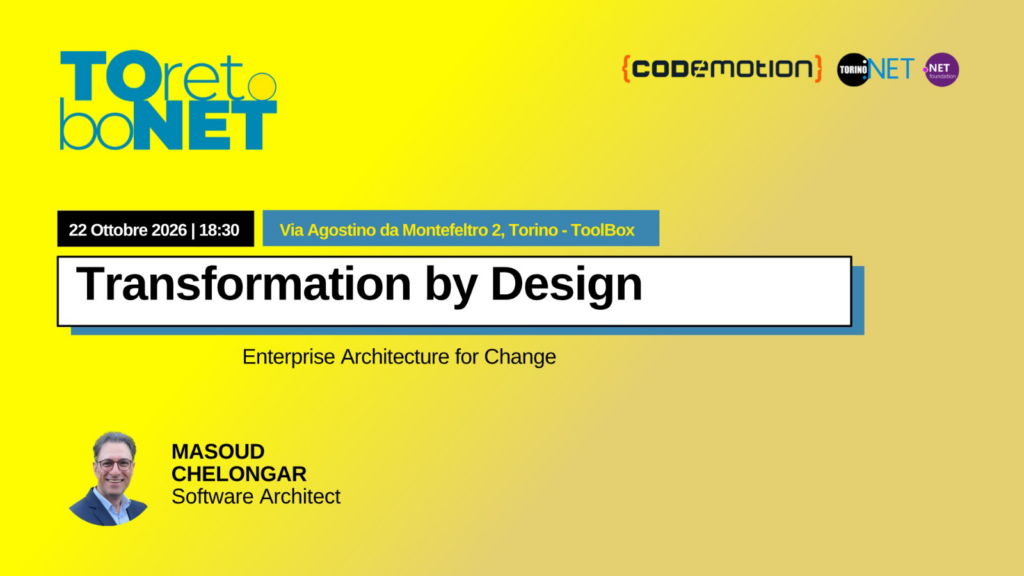
Transformation by Design
Enterprise Architecture for Change


Workshop Overview
Software transformation is not only a technology problem. Enterprise architecture, software architecture, business domains, team structures, organizational dependencies, and feedback loops continuously influence each other.
Working with a realistic transformation scenario, in this session participants will explore how Systems Thinking, Domain Driven Design, EventStorming, and Team Topologies can be combined to discover what is happening across an organization, identify architectural and organizational boundaries, and design systems that can continue to evolve as the business changes.

Part One: Understanding the Sociotechnical Transformation Challenges
We begin by exploring why software transformation is more than a technical challenge. This session examines how software architecture, organizational structures, business domains, decision-making processes, and team dependencies influence one another. Participants will discover common constraints, recurring problems, and hidden dynamics that make transformation initiatives difficult to manage and sustain.

Part Two: Exploring the Solution Space by Introducing SEDA
This session introduces the Systemic Event Discovery Approach (SEDA) as a structured, iterative approach to software transformation. We explore how SEDA brings together Systems Thinking, Domain-Driven Design, EventStorming, and Team Topologies to understand existing systems, redesign around business domains, manage emergent behaviors and feedback, and sustain continuous evolution.

Part Three: Hands-on Workshop by Applying SEDA
Participants will work collaboratively on a realistic software transformation scenario, applying the four steps of SEDA. Through guided exercises, they will examine the existing sociotechnical system, identify structural constraints and domain boundaries, explore potential architectural and organizational interventions, and consider how to observe their effects over time. The emphasis is on practical reasoning, collaborative discovery, and informed transformation decisions.

Part Four: Discussion and Q&A
Participants can share their experiences, raise questions, and explore how the approach could be adapted to their own software ecosystems, teams, and transformation initiatives.